

Safe spaces for designers
How to run design critiques that surface better ideas, create clarity, and protect psychological safety.
In recent conversations with other designers, I was reminded how vital it is to have a safe space to share ideas and receive feedback on your WIPs. This is a re-worked version of a Medium article I posted three years ago that still feels super relevant.
To be a designer is to have your work as the subject of a lot of feedback
Feedback is an important part of the design process and building successful products, but when you’re weeks into a design that has many complex flows, many attentive stakeholders, every line of feedback can feel like death by a thousand cuts.
Everyone can have an opinion on a design, yet it’s not often that they reflect on how the way feedback is framed can alter the trajectory of the end solution.
Design needs a safe space
Embedding safe feedback practices into our design process encourages more scrappy ideas to come to the surface.
When you feel safe, egos stay low, candor can be high, and people feel more comfortable to share all types of ideas, flexing their feedback muscles more regularly. Knowing that ideas can be wrong without the person feeling like they’re wrong.
The teams that build great products are the ones who make it normal to share work early, normal to ask honest questions, and normal to be wrong on the way to being right.
This quote from The Culture Code by Daniel Coyle sums it up nicely:
“Building purpose in a creative group is not about generating a brilliant moment of breakthrough but rather about building systems that can churn through lots of ideas in order to help unearth the right choices.”
This article covers what ‘safe’ actually looks like in practice: what critique is for, when not to use it, and the specific language patterns that keep it constructive.
Why even have a design critique?
Design critiques when run wrong can be places of defensiveness, design-by-committee Frankenstein outputs, or places where direction is so vague/scattered that the designer spirals with no real next step.
A design critique should be a sense check; it’s about asking if we’re on the right track, sharing unpolished ideas, and identifying what we have missed or forgotten with the design solution.
It’s there to enable the designer to gather inputs they need to move forward. It’s up to them to decide which inputs are relevant and worth including in future iterations of their solution.
Even though design critique is a weekly team ritual, they should only be run when they’re useful to the team. These sessions exist only to help the designer who needs support on what they’re currently working on.
Generating ideas — When you’re just getting started, and want to collect any ideas that your team may have already thought of.
Unblocking — Sometimes you can fall into analysis paralysis when looking at a problem or design for too long, and it’s helpful to get other perspectives to move forward confidently.
Elevating quality & consistency of our designs and research — Leveraging existing patterns, exploring new ones, everything from visual design to interaction details to how we plan a research project.
Sharing context & insights — Provide the broader team with a heads-up on what’s about to go into delivery, or what you’re learning or unpacking through research or discovery.
Don’t wait for the meeting to seek feedback
When you’re working fast, it’s vital for feedback to happen at the right time.
There’s nothing worse than someone in leadership giving feedback on something after it’s in production. Now it’s expensive to go back and fix.
I’ve found having a #design-review Slack channel for realtime feedback means sharing WIPs can happen more often without waiting for the formal process.
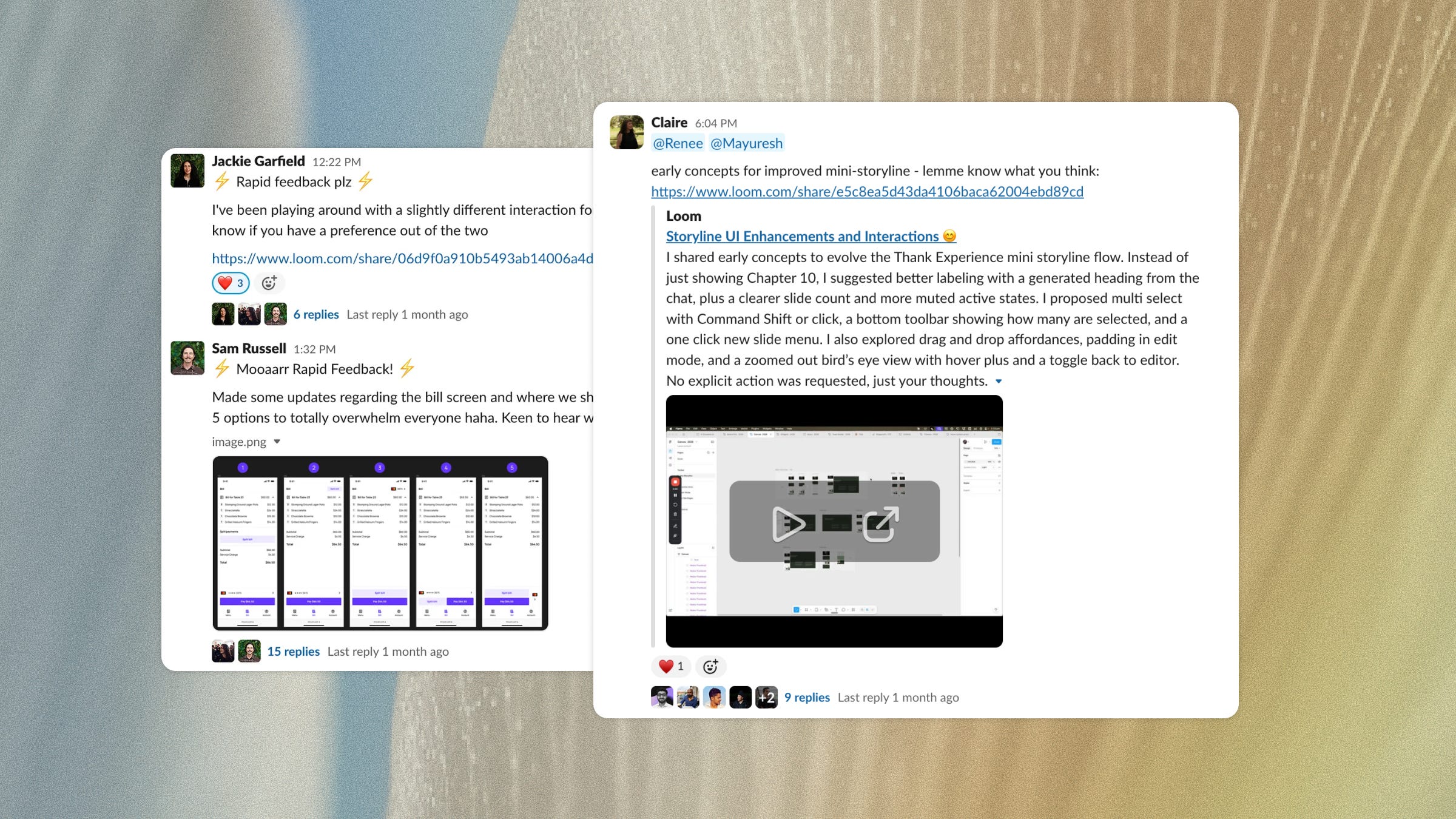
Add variety to how you ask for feedback by sharing Loom video recordings, a Figma prototype, link to a vibe-coded tool, or even an emoji poll to get a quick sense check.
Framing feedback
Designers, researchers, product managers, and engineering leads attend our design critiques, and we often get drop-ins like our CEO or Head of Sales, or team members from customer success, brand, or support.
Given the diverse range of participants, and in order to maintain a safe space where designers feel confident and comfortable to share their work in progress, we start each session by setting intentions, context, and guardrails.
Ask the audience to keep an open mind, to be engaged, be empathetic, and to be constructive. They should be committed to helping the designer move forward.
Provide context on what you’re working on, why it’s important and what success looks like for the design or project.
Provide guardrails for the type of feedback you’re looking for, be specific on what is in and out of the scope of the discussion.
Feedback is a two-way street
As an audience member at a review, you have an important part to play.
Be clear and specific — focus on one piece of feedback at a time. If you’re too vague or broad, the person receiving it may take it the wrong way, or not understand what action to take from your input. Get to the why behind your feedback so it’s easier for the designer to know what you mean.
Frame your feedback as a question — by framing your feedback as a question (”have you considered…”, “what if…”), you’re inviting the designer to show more of their rationale or to think of other options, not just the one you’ve presented.
Frame your feedback as subjective — Your feedback is still an assumption until validated with real users. Use statements like “I could be wrong” or “this is just my opinion/bias” to let the designer know it’s okay if they disagree. Ask the designer how they plan on testing their solution, or ask whether they think it’s worth validating your feedback.
If your feedback patterns fall into these traps, then it’s not useful:
Vague feedback (“I don’t like it”)
Solution-jumping too early (“Just make it blue”)
Power dynamics hijacking (“CEO said it should be green”)
Piling on (10 people commenting on the same detail)
Building rapport is crucial to providing feedback people will absorb well. To put your work out there is to be vulnerable. If the recipient knows that you really care about them and their growth, they’ll be more receptive to your comments on their work.
As Julie Zhuo writes in her book, The Making of a Manager:
“Your feedback only counts if it makes things better.”
Use AI as a critic
If critique feels high-stakes, rehearse privately first. AI can help you pressure-test before you share with humans. I especially found this useful as a design team-of-one.
Try out this prompt:
Review this [design/flow/prototype] and provide feedback on usability, UI design, interaction and flow.
Flag usability issues and where clarity is missing. Suggest alternative solutions.
Help me improve my thinking by highlighting potential assumptions or flaws, and raising tough questions that encourage deeper reflection.
Be constructive and respectful, aiming to strengthen the end solution.
Putting work up for critique is one of the most vulnerable things we do as designers.
It’s not just “a screen”—it’s your judgment, your taste, your time, your effort, on display. That’s why safety matters.
When critique is framed with care, it becomes energising: a place where you can think out loud, try scrappy ideas, and leave with a clear next step.
The goal of a good design critique isn’t to win a room. It’s to ship a stronger solution.
Appendix
Here are some other feedback frameworks you might find useful:
IDEO critique prompts:
I like… (specific, not generic praise)
I wish… (a desire framed softly)
What if… (opens possibility space without commanding)
The “Ladder of Feedback”
Clarify (ask questions, make sure you understand)
Value (what’s working / what you like)
Concerns (what might not work + why)
Suggestions (ideas, alternatives)
Critique-by-fidelity:
Early / low-fidelity: question-led, concept & intent
Mid / iterative: flow + usability + priority tradeoffs
Late / high-fidelity: craft, consistency, edge cases
Silent Review
First 10 minutes, everyone reviews design in silence, adds sticky notes or comments directly to file.
Designer then walks through feedback, seeking clarification without needing to drill into minor polish comments.
Hi Claire!!! I really love the way you write, and the way you think, and it would mean the world if you joined my community by subscribing to my Substack(I WILL TOO)!! Thanks!